
Table of Contents
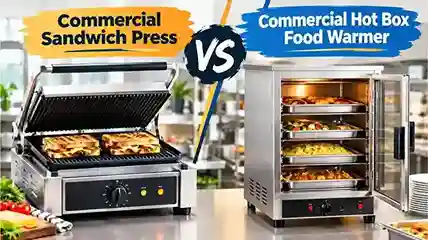
Commercial Sandwich Press vs Commercial Hot Box Food Warmer when running a restaurant, a café a food truck, a catering company, a bakery or a commercial kitchen picking the equipment can have a big impact on how things run every day. Two pieces of equipment that do different things are a commercial sandwich press and a commercial hot box food warmer. Even though both can be helpful in a food-service setting they are made for completely different tasks.
A commercial sandwich press is mainly used to cook, toast, grill and press sandwiches and other foods. A commercial hot box food warmer is meant to keep cooked food warm and ready to serve without needing to cook it
Knowing the differences between these two machines can help restaurant owners and food-service workers choose equipment that fits their menu how their kitchen works how space they have and what their customers want.
In this guide we will look at a sandwich press versus a commercial hot box food warmer. We will talk about what they do the things about them the bad things how much energy they use how much they can hold how easy they are to clean and when they are best to use.
What Is a Commercial Sandwich Press?
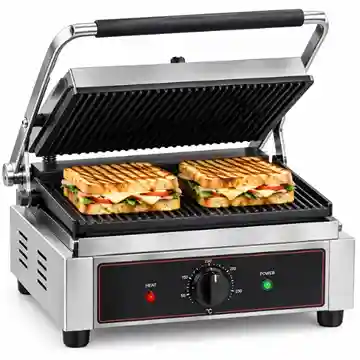
A commercial sandwich press is a kitchen machine made for making sandwiches and other foods that are pressed or grilled. Unlike home sandwich makers commercial versions are made to handle a lot of use and a lot of work.
Depending on how it’s made a commercial sandwich press might have one or two heated plates. These plates add heat and pressure to the food so sandwiches become crunchy on the outside and the inside ingredients get warm.
Many models can be used for foods like panini, grilled cheese sandwiches, burgers, wraps, quesadillas and other items that are pressed.
Commercial sandwich presses are especially helpful, for cafés, restaurants, food trucks, delis, bakeries and places that serve breakfast where toasted or grilled sandwichesre on the menu.
Key Features of a Commercial Sandwich Press
Some common features are:
- Strong stainless-steel build
- Adjustable temperature settings
- Plates that’re either bumpy or smooth
- Big cooking areas
- Temperature control that stays steady
- Handles that don’t get hot
- Heats up quickly
- Surfaces that’re easy to clean
- Ability to cook at high temperatures
The exact features depend on the model so companies should think about what they serve and how much work they expect before buying.
What Is a Commercial Hot Box Food Warmer?
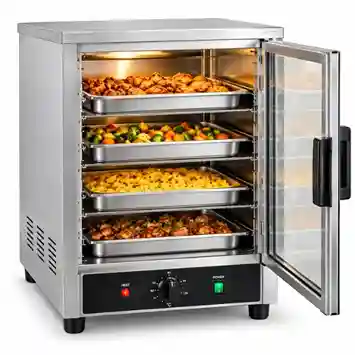
A commercial hot box food warmer is made for keeping cooked food warm and ready to serve. It does not take the place of cooking machines. Instead it helps keep food at the temperature after it has been cooked.
Hot boxes are often used by restaurants, catering companies, cafeterias, hotels, hospitals, schools, bakeries and delivery businesses.
For instance a catering company might cook meals ahead of time. Of serving all of them right away the meals can go into a hot box to stay warm until customers are ready to eat.
Many commercial food warmers use boxes, heated air or controlled heat to keep food at the right temperature.
Key Features of a Commercial Hot Box Food Warmer
Depending on the model features may include:
- Insulated cabinet construction
- Adjustable temperature controls
- Multiple tray levels
- Large holding capacity
- Stainless-steel interior
- Digital temperature display
- Removable racks
- Designs
- Heated or non-heated insulation options
The main goal is food holding than food preparation.
Commercial Sandwich Press vs Commercial Hot Box Food Warmer
Although both appliances are used in kitchens their purposes are fundamentally different.
A sandwich press. Reheats food through direct contact with heated plates. A hot box holds prepared food at a serving temperature.
Choosing between them therefore depends heavily on what your business needs to accomplish.
Cooking vs Food Holding
The biggest difference between these appliances is their function.
A commercial sandwich press is a cooking appliance. It can apply heat and pressure to ingredients making it suitable for preparing sandwiches and other foods.
A commercial hot box is a holding appliance. Food is normally cooked else and then transferred into the warmer.
For a café that specializes in panini and grilled sandwiches a sandwich press may be a part of daily production.
For a catering company that prepares hundreds of meals before an event a hot box may be more useful because the main challenge is keeping food warm until service.
Capacity
Capacity is another difference.
Commercial sandwich presses usually have a limited cooking surface. Even a large press can only prepare a number of sandwiches at once.
Hot boxes are designed around food-holding capacity. Many models contain shelves or tray levels allowing operators to store numerous prepared meals simultaneously.
If your business serves toasted sandwiches made to order the smaller capacity of a sandwich press may not be a problem.
However if you prepare quantities of food in advance a hot box can provide significantly more holding capacity.
Speed and Workflow
A sandwich press can be very efficient when customers order food individually.
For example a café worker can place a sandwich into the press close the lid and allow the heated plates to toast it. Once finished the sandwich can be served immediately.
This type of workflow works for made-to-order menus.
A hot box supports a workflow. Food is prepared in batches. Then stored temporarily for service.
This can be particularly helpful, for catering and buffet operations where food preparation happens before customers arrive.
I have found that a sandwich press can be very efficient when customers order food individually.
For example a café worker can place a sandwich into the sandwich press close the lid and let the heated plates toast the sandwich. Once the sandwich press finishes the sandwich can be served immediately.
This type of workflow works well for made‑to‑order menus.
A hot box supports a workflow. Food is prepared in batches. Then stored temporarily for service in the hot box.
This can be especially helpful for catering and buffet operations where food preparation happens before customers arrive.
Temperature Control
Temperature control is important for both a sandwich press and a hot box. The purpose is different.
A sandwich press needs heat to cook or toast food effectively. Adjustable temperature settings let operators work with ingredients and recipes on the sandwich press.
A hot box is designed to keep food at a controlled holding temperature. Precise temperature management is especially important in food service because food should be handled and held according to applicable food‑safety requirements in the hot box.
Operators should always follow food‑safety regulations and the manufacturers instructions for the sandwich press and the hot box.
Energy Consumption
Energy consumption depends on the appliances size, power rating, operating temperature, insulation and usage pattern for the sandwich press and the hot box.
A sandwich press generally uses power to heat its cooking plates. The sandwich press may cycle on and off through a thermostat while operating.
A hot box also uses energy if it is electrically heated. However good insulation can help reduce heat loss in the hot box.
Businesses should check the wattage and operating requirements of models instead of assuming that one category will always consume less electricity.
Cleaning and Maintenance
Cleaning is a consideration in commercial kitchens.
A sandwich press can collect grease, crumbs, melted cheese, sauces and food residue on its cooking plates. Regular cleaning is therefore necessary for the sandwich press.
Models with easy‑clean plates may simplify maintenance for the sandwich press.
A hot box may be easier to clean in some applications because it primarily holds food trays than cooking food directly. However spills and food particles can still accumulate inside the cabinet of the hot box.
Stainless‑steel interiors and removable racks can make cleaning more convenient for the hot box.
Regardless of the equipment type the manufacturers cleaning instructions should be followed for the sandwich press and the hot box.
Advantages of a Commercial Sandwich Press
A sandwich press offers several advantages for businesses that prepare toasted or grilled foods.
Excellent for Sandwiches
The sandwich presss primary advantage is the ability of the commercial sandwich press to prepare hot crispy sandwiches quickly.
Fast Cooking
Once the commercial sandwich press reaches the desired temperature the commercial sandwich press can cook food quickly.
Consistent Results
The commercial sandwich press can provide pressure and heat helping businesses maintain similar results across orders.
Space Efficient
Many countertop models of the sandwich press occupy relatively little space compared with larger commercial cooking equipment.
Versatile Applications
Besides sandwiches some commercial sandwich presses can be used for wraps, quesadillas, grilled vegetables and other foods depending on the cooking surface and manufacturer’s recommendations.
Limitations of a Commercial Sandwich Press
Despite its benefits a sandwich press is not suitable, for every food‑service operation.
The sandwich presss cooking surface limits how much food can be prepared simultaneously. It also does not provide the holding capacity of a food warmer.
Additionally food prepared on a sandwich press generally needs to be served soon if you want to maintain the sandwich presss intended texture and quality.
A sandwich press therefore works best when the business has a menu that requires grilled or toasted food.
Advantages of a Commercial Sandwich Press
A commercial sandwich press offers advantages for businesses that prepare toasted or grilled foods.
Excellent for Sandwiches
The main benefit is the ability to make crispy sandwiches in a short amount of time. The press ensures cooking on both sides giving each sandwich a consistent texture and color.
Fast Cooking
Once the press reaches the temperature it starts cooking quickly. This helps reduce waiting time for customers and improves kitchen efficiency.
Consistent Results
A commercial sandwich press applies pressure and heat across the food. This consistency means every sandwich comes out the same, which is important when managing high volume orders.
Space Efficient
commercial sandwich presses are designed to fit on a countertop. They take up room than ovens or grills making them ideal for kitchens with limited space.
Versatile Applications
Beyond sandwiches some models can cook wraps, quesadillas, grilled vegetables and more. The type of cooking surface and the manufacturer’s recommendations determine what kinds of food work best.
Limitations of a Commercial Sandwich Press
Even though a sandwich press has benefits it does not suit every business. The size of the cooking surface limits how much food can be made at one time. It also cannot hold amounts of prepared food like a warmer can.
Food cooked on a sandwich press must be served soon after preparation to keep its crispiness and quality. If kept long it can become soggy or overcooked. That means this equipment works best for menus that rely on made grilled or toasted items.
Advantages of a Commercial Hot Box Food
A commercial hot box is especially useful when food needs to stay warm after being cooked.
Holding Capacity
Hot boxes often have multiple shelves or trays. This allows staff to store a batch of prepared meals without needing extra storage units.
Useful for Catering
Catering companies frequently use boxes to transport meals from the kitchen to events. The boxes help keep food at the serving temperature during travel and setup.
Better Batch Workflow
of preparing dishes one at a time businesses can cook in larger batches and keep them warm until they are needed. This saves time. Keeps the kitchen running smoothly.
Helpful, for Buffets
Restaurants and caterers who serve buffet-style meals can use boxes to keep dishes warm and ready for guests. This helps maintain food quality throughout service hours.
Reduces Immediate Service Pressure
With food already prepared and held in a controlled environment staff don’t need to rush every order. This makes handling groups easier and reduces stress during busy times.
Limitations of a Commercial Hot Box Food Warmer
A hot box does not replace a cooking appliance.
The hot box is designed to hold food than prepare raw ingredients. Therefore businesses still need cooking equipment.
Food quality can also change if meals are kept for long. Some foods may lose crispness or texture during holding.
For example crispy fried foods may become softer over time in an environment. Kitchen staff should therefore think about how particular foods can be kept while keeping good quality.
Which One Is Better for a Restaurant?
There is no choice that works for every restaurant.
If your menu focuses on panini, grilled sandwiches, toasted bread, quesadillas or similar foods a commercial sandwich press may fit your workflow.
If your restaurant prepares quantities of cooked meals and needs to hold them before service, a commercial hot box food warmer may be more useful.
Some larger operations may actually benefit from having both.
For example a café could use a sandwich press to prepare sandwiches to order while using a box to keep prepared breakfast items or catering orders warm.
Which One Is Better for Catering?
Catering operations often have equipment requirements than small cafés.
A catering company may prepare food in a kitchen and then transport it to an event. Keeping meals warm during staging and service can be a major logistical consideration.
In this situation a commercial hot box food warmer can be highly useful.
A sandwich press could still be valuable if the catering menu includes grilled sandwiches but it does not provide the same food-holding function.
What Should You Consider Before Buying?
Before purchasing either appliance consider factors.
Menu
Look at the foods you actually sell. If grilled sandwiches are a part of your menu a sandwich press may make sense.
If your business handles prepared meals in batches consider a hot box.
Volume
Estimate how meals or sandwiches you need to prepare or hold during your busiest period.
Higher-volume businesses may require larger‑capacity equipment.
Available Space
Measure your countertop or kitchen space before purchasing. Also consider ventilation, electrical requirements, access and cleaning space.
Temperature Range
Check the manufacturer’s stated temperature range and controls to make sure the appliance is appropriate for your intended use.
Construction
Stainless steel is common in food‑service equipment because it is durable and relatively easy to clean.
Ease of Cleaning
Look for components, accessible surfaces and designs that make routine cleaning easier.
Electrical Requirements
Check voltage, wattage, plug type and circuit requirements before installation.
Commercial Sandwich Press vs Commercial Hot Box Food Warmer: Final Comparison
The two appliances serve purposes.
A commercial sandwich press is primarily a cooking tool for grilling, toasting and pressing food. It is particularly useful for cafés, delis, restaurants and food trucks that serve sandwiches made to order.
A commercial hot box food warmer is primarily a food‑holding solution. It is useful for catering businesses, cafeterias, restaurants, hotels and other operations that need to keep food warm before serving.
The right choice depends on your workflow than simply the size or price of the equipment.
If your biggest need is cooking sandwiches quickly and consistently focus on a sandwich press.
If your biggest need is holding meals for service a commercial hot box food warmer may be more appropriate.
For businesses, with high‑volume operations and varied menus using both appliances can provide a complete workflow. The sandwich press handles preparation while the hot box manages prepared food that needs to remain warm.
Ultimately compare capacity, temperature controls, construction quality, energy requirements cleaning features, available kitchen space and your expected daily workload before making a purchase.
Choosing equipment based on your operation can help create a smoother kitchen workflow and improve consistency during busy service periods.

1 Comment
[…] What Should You Look for When Buying a Grinder? […]