
Table of Contents
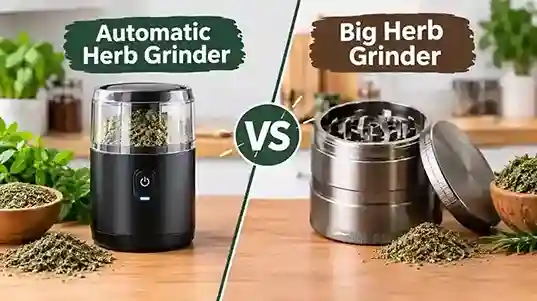
Choosing the grinder can make preparing dry herbs, spices and other ingredients much easier. Two popular choices are a herb grinder and a big herb grinder. Although both are designed to break materials into smaller pieces they offer very different experiences.
An automatic herb grinder focuses on convenience and reduced manual effort while a big herb grinder generally provides capacity and more control over the grinding process. The better option depends on what you grind how you use the automatic herb grinder how much material you need to process at once and whether portability matters to you.
In this guide we compare a herb grinder versus a big herb grinder in detail. We will look at design, grinding performance, capacity, ease of use, cleaning, portability, durability and overall value.
What Is an Automatic Herb Grinder?
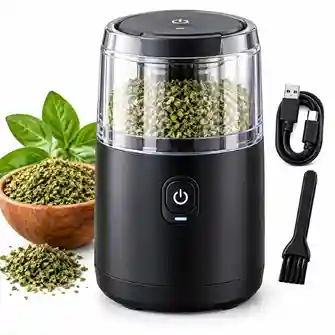
An automatic herb grinder is a battery‑powered or electrically powered device that uses a motor to grind materials. Of turning a grinder manually the user activates the motor and allows the internal mechanism to perform the work.
The biggest advantage of a herb grinder is convenience. Automatic operation can be particularly useful for people who process culinary herbs, spices, tea ingredients or other suitable materials regularly.
Many automatic herb grinders are compact and designed for operation. Some use push‑button controls while others operate with a press‑and‑hold mechanism.
Because the motor performs the grinding users do not need to rotate a manual grinder. This can make the process faster and more comfortable for use.
However automatic herb grinders also contain mechanical components. Batteries need charging or replacement. The motor may require additional care compared with a simple manual grinder.
What Is a Big Herb Grinder?
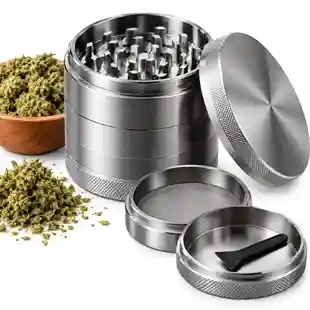
A big herb grinder is a manual grinder designed to accommodate more material than a compact grinder. These big herb grinders commonly feature chambers and larger grinding surfaces.
The primary benefit of a herb grinder is capacity. If you need to process amounts at once a big herb grinder can reduce the number of batches required.
A big herb grinder is also relatively straightforward mechanically. There is no motor, battery or charging system. You simply place the material inside and rotate the big herb grinder.
Because of their construction many big herb grinders can be durable and easy to maintain. Their performance depends on the quality of the teeth the construction material and how smoothly the grinding mechanism rotates.
Automatic Herb Grinder vs Big Herb Grinder: Main Differences
The biggest differences, between a herb grinder and a big herb grinder involve convenience, capacity, control, maintenance and portability.
An automatic herb grinder is primarily designed for operation. A big herb grinder focuses more on capacity and mechanical simplicity.
Here is a quick comparison:
| Feature | Automatic Herb Grinder | Big Herb Grinder |
|---|
| Operation | Motor-powered | Manual |
| Effort | Very low | Requires hand rotation |
| Capacity | Usually small to medium | Medium to large |
| Portability | Often compact | Usually larger |
| Power | Battery or electricity | No power required |
| Control | Depends on model | More direct manual control |
| Maintenance | Motor and battery care | Mainly cleaning |
| Noise | Motor noise | Generally quieter |
| Batch Size | Smaller to medium | Larger |
| Convenience | Very high | Moderate to high |
Grinding Performance
I have seen that grinding performance depends a lot on the grinder’s design. An automatic grinder uses a motor to turn its grinding parts. A big manual grinder on the hand relies on the person’s hand motion.
I notice that an automatic grinder can give work because the motor keeps the grinding action going. Some automatic grinders are built to run for a time and then stop by themselves.
I think a large manual grinder gives a lot of control. A person can decide how to turn the manual grinder and shut it off whenever the texture is just right.
I find that, for cooking this control can be helpful because different recipes may need particle sizes from the grinder.
I have found that some dried herbs can be better when the manual grinder breaks them lightly of grinding them very fine.
Capacity
Capacity is one of the differences between an automatic grinder and a big grinder.
Automatic grinders often prioritize compactness. Their smaller size makes them convenient to store and to carry. It can limit how much material they can process in one cycle.
Big grinders are generally designed with interior space. This lets users process batches without repeatedly opening the grinder and adding more material.
If you regularly prepare quantities of dry culinary herbs or spices a big grinder may be more practical.
On the hand if you usually work with small quantities the extra size of a big grinder may not give much benefit.
Ease of Use
Automatic grinders have an advantage when it comes to reducing physical effort.
Of manually rotating the grinder you activate the motor and let it do the work. This can be useful when you grind frequently or when you simply prefer a push‑button experience.
Large manual grinders are still relatively easy to use. Their basic mechanism requires no setup. Add the material close the grinder rotate the top and collect the processed material.
The choice therefore comes down to convenience versus simplicity.
Portability
Portability can be important if you need to keep your grinder in a kitchen drawer, travel bag or storage container.
Compact automatic grinders can be convenient because many are relatively small.
However battery‑powered models need to be charged, which can become an inconvenience if the battery runs low.
Big grinders naturally take up space.
Their bigger dimensions can make them less convenient for storage.
For home use where storage space’s not an issue the larger size may be worthwhile because of the extra capacity.
Materials and Durability
The material used in a grinder can have an effect on its durability.
Common construction materials include aluminum, stainless steel, plastic and various composite materials.
Metal grinders are generally valued for their strength and long‑term durability.
Stainless steel is especially useful when easy cleaning and resistance to corrosion are priorities.
Some automatic grinders may use metal grinding components combined with an exterior.
This can help keep the device lightweight while protecting the motor.
When choosing a grinder pay attention not to the outside housing but also, to the quality of the internal grinding mechanism.
Cleaning and Maintenance
Cleaning is another point to think about.
A large manual grinder usually has parts so maintenance is easier. After use remove leftover particles. Clean the surfaces that the manufacturer says to clean. I find that cleaning a grinder is simpler.
Automatic grinders need care because they have motors and electrical parts. Do not expose these parts to water unless the manufacturer says they can be washed.
For models follow the manufacturers instructions for charging storing the battery and cleaning.
Regular maintenance can stop residue from building up and keep the grinder running smoothly.
Noise Level
I think noise can also affect your choice.
A manual grinder is usually quiet because it uses physical movement. That makes it good for places where you want to keep noise
Automatic grinders have motors so they will make some noise. The amount of noise varies a lot between models.
If quiet operation matters most a large manual grinder might be the choice.
Storage
I think storage needs should not be ignored.
A large grinder takes up cabinet or drawer space.. Its big capacity might mean you do not need extra containers for small batches.
Automatic grinders are usually easier to store because they are compact. Because they have parts keep them in a dry place away from too much heat or moisture.
Before buying either type think about where you will keep it when it’s not in use.
Which One Is Better for Frequent Use?
For frequent general‑purpose grinding an automatic grinder can be handy because it reduces effort.
Pressing a button of turning a grinder many times can save time on repeated tasks.
Frequent users who grind large amounts might like a big grinder because it holds more and is simple to build.
The best choice depends on whether you value convenience or batch size for your routine.
Which One Is Better for Batches?
A big grinder usually makes sense when capacity matters most.
Its big chamber can hold dry material, which can cut down the number of grinding cycles needed.
An automatic grinder can still be useful, for batches but its compact size can limit how much you can process at once.
If you often make amounts of culinary herbs, dried ingredients or spices check the capacity the manufacturer says before buying.
Which One Is Easier to Maintain?
A large manual grinder usually has maintenance needs.
There is no battery, no charging port, no motor and no electronic control system. Fewer parts usually mean things that need attention.
Automatic grinders can still be easy to maintain. People need to take extra care around the motor and the electrical parts.
For someone who likes tools a manual grinder might be more attractive.
What Should You Look for When Buying a Grinder?
Before buying either type think about important features.
Construction Material
Look for materials and a solid grinding part. Stainless steel and good aluminum are often used for strength.
Capacity
Pick a size that fits the amount of material you usually work with. A bigger grinder is not always better if you only handle amounts.
Grinding Mechanism
Check how the teeth or grinding parts are made. Strong made parts can give better and more even results.
Ease of Cleaning
A grinder that’s hard to clean can be a problem over time. Look for designs that let you reach areas where leftovers might build up.
Portability
If you plan to move the grinder think about its size and weight.
Power Needs
For ones check what kind of battery how to charge it and how long it works. A manual grinder doesn’t need any power.
Pros and Cons of an Automatic Herb Grinder
Pros
- physical effort needed
- Easy push-button use
- Often small in size
- Good for small amounts over and over
- Quick and easy to use
Cons
- Needs batteries or electricity
- Motor can make noise
- More parts to look after
- Usually not as big
- Can cost more than simple manual designs
Pros and Cons of a Big Herb Grinder
Pros
- Bigger size
- No batteries needed
- Simple moving parts
- Easy to use
- Often lasts a long time
- Good, for big amounts
Cons
- Needs hand power
- Takes more space
- Harder to carry
- How fast it works depends on the person using it
Final Thoughts
The choice between a herb grinder and a big herb grinder finally depends on what you need personally.
An automatic grinder focuses on ease, quickness and less work with your hands. It can be an option, for people who often handle small amounts and like something that works with a motor.
A big manual grinder focuses on how much it can hold how easy it is and how much you can control. It can be very helpful when you need to work with amounts and don’t want to use batteries or power.
Before you buy think about how much it can hold, what it is made of how it grinds, how easy it is to clean how easy it is to carry and how strong it’s. Of just picking based on size or looks pick a grinder that matches how you really plan to use it.
For cooking and using dry herbs both types can work well if you pick the right one. The best choice is the one that fits your amount of work, where you keep it how much you want it to be easy and how much you want to take care of it.

1 Comment
[…] How to Choose the Right Coffee Maker […]