
Table of Contents
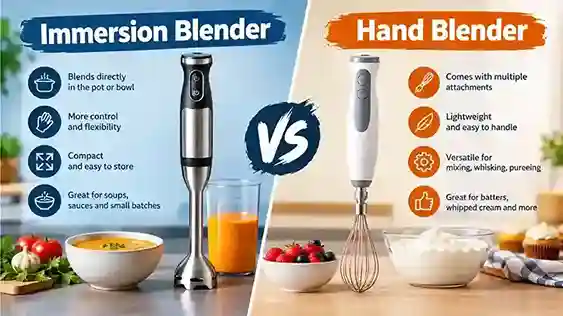
Immersion Blender vs Hand Blender Choosing the right kitchen appliance will help you quickly, easily and even more so enjoy your cooking. when it comes to blending soupes sauces smooties and other recipes many shoppers are confronted with two terms immersion blender vs hand blender.
Difference Between Immersion Blender Vs Hand Blender Are those different appliances, or are these just names for the same kitchen tool?
More often than not, a personalized blender and portable mixer are simply two phrases for any semi-3 sizable blending appliance. This handheld device is a little upside down compared to a countertop blender; it has the motor at the top and the blending blade on the bottom. You put the blade in a container, pot, bowl or cup and simply blend without having to move your contents to a different container, blender jar.
But the models will be in different power levels, attachment, speeds and designs. We will discuss the features of immersion blender vs hand blender, and compare them in terms of performance, convenience, cleaning ease, portability & value-for money to help you decide which is best for your kitchen.
Immersion Blender vs Hand Blender at a Glance
| Feature | Immersion Blender | Hand Blender |
|---|
| Basic design | Handheld blending tool | Handheld blending tool |
| Main use | Soups, sauces, smoothies | Soups, sauces, smoothies |
| Direct blending | Yes | Yes |
| Container required | Any suitable container | Any suitable container |
| Storage | Easy | Easy |
| Cleaning | Usually simple | Usually simple |
| Attachments | Depends on model | Depends on model |
| Portability | Excellent | Excellent |
| Best for | Quick everyday blending | Compact kitchen tasks |
The important point is that immersion blender and hand blender are commonly interchangeable names. The bigger difference usually comes from the individual model and its features rather than the name.
What Is an Immersion Blender?
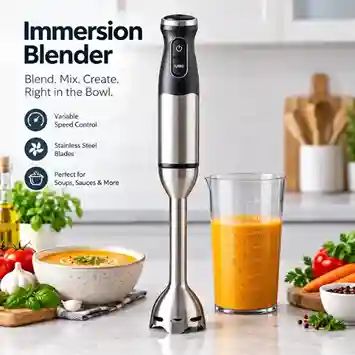
The immersion blender is a small hand-held device for blending food within the vessel it will be served from.
Instead of having a traditional countertop blender for pouring soup, or sauce as you have to put it there from the pot, you can stick the immersion blender into the pot and blend until you reach your desired consistency.
Here are some common uses for immersion blenders because of the way they are designed:
- Soups
- Sauces
- Gravies
- Smoothies
- Baby food
- Purees
- Salad dressings
- Milkshakes
- Dips
Most models come with a detachable blending shaft, which makes cleaning and storage much easier.
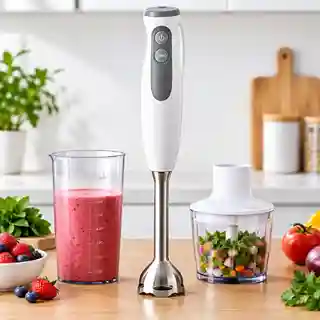
Many high-end immersion blenders come with attachments, like a whisk and food processor bowl or measuring beaker.
What Is a Hand Blender?
Essentially, however, a hand blender is just another name for an immersion blender.
The word hand blender is used because of the way it looks like a hand held machine. You can basically hold the unit with motor in one hand and let a spinning blade do all the work inside your ingredients.
Depending on the manufacturer, a product may be sold as one of the following: hand blender, stick blender, immersion blender or stick mixer.
For shoppers, it means ignore the name and just look at the specifications.
Before buying make sure you look for the motor power, speed controls, blade design, attachments, materials used, warranty and customer reviews.
Immersion Blender vs Hand Blender: Are They Actually Different?
One of the most frequent questions that shoppers ask
Generally, there is very little difference between an immersion blender and a hand blender in most cases. Typically, both terms refer to the same type of small kitchen appliance.
The difference is mostly just what different brands and retailers call things.
To illustrate, manufacturer A might refer to a certain blender as a “5-Speed Immersion Blender,” while manufacturer B markets an essentially identical product under the name “Variable-Speed Hand Blender.”
They perform almost the same basic function.
So, if you are online searching for one thing use all 3 common terms:
Also known as: Immersion blender, hand blender, stick blender.
This can lead you to finding additional vehicles and comparing prices and amenities.
Power and Blending Performance
A key factor in how effective an immersion blender can be when blending up different ingredients is its power (or wattage). Lower-powered models simply won’t be able to move thicker, tougher mixtures as easily as a model with a more powerful motor.
If your only use is simple tasks like blending cooked veggies, soups, sauces, soft fruits and purées a basic immersion blender might have more than enough power. But if you tend to regularly prepare thicker mixes, frozen produce and other dense ingredients, opting for a higher-powered model may make the process easier.
Blending performance is not only dependent on the power you feed. The blade design, motor efficiency, speed settings, and construction quality also play a role in the outcome.
A good blade can encourage ingredients to gather and mix around the blending area, giving a better texture with less work.
Don’t just look at the wattage number, compare models instead. Think about the type of food you typically make and select a blender that is suited to those functions.
With a powerful immersion blender, speed is another benefit. The amount of time the mixer will actually need to reach a smooth consistency can be minimized with a more powerful motor. This can be helpfull n when we arrange large pots of soup or sauces.
But not all the time, more power is needed. If your blender work mostly consists of the occasional smoothie, salad dressing, soft fruits or cooked vegetables, then you likely won’t get much added value from an incredibly powerful model.
Unless you are a professional chef, the best option is usually a world that meets the power needs of your normal formulas but is still comfortable and easy to control.
Speed Settings
Basic hand blenders may come with one or two speed settings, but more advanced models can provide multiple different speeds and/or variable-speed controls.
The multiple speed settings give you more control with the https://www.thefancyes.com/?pg=design-beautiful-bakery-box guessing the texture.
Low speed is helpful for folding ingredients in gently while speeds are beneficial for purees and drinks that require a smoother consistency.
Certain models even come equipped with a turbo button for a temporary boost of maximum power.
If you use different recipes regularly then adjustable speed is a good quality and it will be valuable for the price.
Convenience and Ease of Use
Convenience is one of the main pros of a hand blender.
A traditional countertop blender typically requires you to put your ingredients in a blending jar. Once blended you have another vessel to clean.
With an immersion blender, much of this process is eliminated.
For instance, if you are preparing a vegetable soup, you can cook the vegetables in a big cooking pot and then blend the soup directly in that very same pot.
This will help you save time and clean less set of plates.
This simple benefit can make an immersion blender one of the most handy small kitchen appliances for busy households.
Immersion Blender for Soups and Sauces
An immersion (stick) blender is particularly useful if you often make homemade soups.
Could blend directly in the pot to control your texture for an airing
This also friends us tomato sauces, gravies, currys and purees.
Instead of pouring hot ingredients into a countertop blender, you can usually blend them right in the cookware (as long as both are suitable for this step and instructions about suitability & safety from your manufacturer have been followed!
This can simplify cooking into a less messy and more productive endeavor.
Smoothies and Drinks
Immersion blender is useful for smoothies and such too, especially if you have a tall blending cup.
But if you predominantly whip up thick frozen-fruit smoothies or larger batches, a full-size countertop blender might work better.
A handheld blender is usually better for single-type of smaller servings and regular convenience using on daily basis.
This is great if your intended purpose of making a single serving smoothie since its compact design is a plus.
Attachments and Accessories
Not every hand blender is limited to blending.
Some models come with additional accessories that can expand their usefulness.
Common attachments include:
Whisk Attachment
Whisk You have a huge amount to do with a whisk, from beating eggs to whipping cream, pancake batter or light sauces.
Chopper Attachment
Get a food-processing bowl that can chop herbs, onions, nuts and other ingredients.
Measuring or Blending Cup
Higher vessel ease of blending on small amounts reduces splashing.
Detachable Blending Shaft
It features a removable shaft for easy cleaning and storage.
However, if you want a single device to take care of multiple kitchen measurements, choosing a model that includes useful accessories can create more value in the long run.
Cleaning and Maintenance
Immersion and hand blenders also excel when it comes to cleaning.
Most models offer some sort of detachable blending arm that easily rinses or washes apart from the motor housing.
Other attachments may also be dishwasher-safe, but always refer to the manufacturers instructions on whether parts go in a dishwasher.
It is generally a good idea to get rid of the blade and shaft after blending as soon as possible. Dried food is also much harder to remove later on.
Do not submerge the motor housing unless the manufacturer expressly states that it is waterproof or purpose-built for such use.
Storage and Kitchen Space
When it comes to small kitchens storage space is important.
Because of its base and the often oversize blending jar, a classic countertop blender can be quite space-consuming.
An immersion, or hand blender has a lot lower profile.
So you may want to leave it inside a drawer in your kitchen, in a cupboard or an organizer for appliances.
That makes it an excellent option for apartments, dorm rooms, RV kitchens, and other limited-space cooking environments.
Corded vs Cordless Hand Blenders
Another main option is the choice between a corded and cordless model.
Corded Models
Corded immersion blenders offer stable power supply as long they are plugged into a wall outlet.
Then they can be more appropriate for rounds of various cooking and longer blend occasions.
The only downside is the power cord can sometimes get in the way.
Cordless Models
Cordless ones run on rechargeable batteries, so they give you more freedom of movement.
These can be good if managing cords is difficult based on your kitchen layout.
But with regards to buy, battery life and charging time should be considered.
Check the manufacturer’s recommended operating time if you do bigger batches or blend heavier ingredients often.
Safety Considerations
Handling of immersion blenders is critical because it has fast-moving blades.
Before the appliance is turned on, always ensure that the blade stays immersed as advised by the manufacturer. Never put your fingers close to the blade even when the device is not operating.
extra care should be taken whilst blending hot liquids, as splashes could scald.
And never, ever run the blender outside of recommended operating limits and only use the cleaning and maintenance procedures specified by your manufacturer.
You can also consider buying safety features like tight controls, hand grips and protective blade guards.
Immersion Blender vs Hand Blender: Price and Value
Since these terms generally refer to the same type of tool, price differentials tend to hinge on model features rather than whether a device is called an immersion blender or hand blender.
The good news is that basic models are cheap, and may be adequate for more occasional use.
Higher-end models may start at a greater price due to:
- More powerful motors
- Variable speed controls
- Stainless-steel shafts
- Multiple attachments
- Better ergonomic designs
- Rechargeable batteries
- Improved durability
While comparing prices, consider how frequently you will use the appliance.
Basic Model: If soup is a dish you only make from time to time, a basic model works. If you use it often and want one that can do a lot of different things, paying more is probably worth it.
Immersion Blender: Features, Benefits, and Performance
pors
Compact and easy to store
Simple to use
Crops that directly blend through pottingbinations/smooth containers
Easy to clean
Excellent for soups and sauces
Useful for small portions
Typically more budget-friendly than countertop blenders
Many models include helpful attachments
Cons
Not the best for large batches
Might not work with some very hard ingredients
Can splash a bit if not used well
Performance varies significantly between models
Not as speed controllable because of its design
Hand Blenders Pros and Cons
Because a hand blender is essentially the same instrument, two significant advantages areas of opportunity are relatively alike.
Pros
- Lightweight and portable
- Requires little storage space
- Convenient for everyday recipes
- Easy to clean
- Excellent for quick blending
- May include whisking and chopping accessories
Cons
- Requires manual handling
- Not designed for heavy-duty blending.
- Smaller blending capacity
- Corded models require an outlet
- Battery-powered models require charging
Which One Should You Buy?
The key thing to understand is that if you’re comparing the immersion blender vs hand blender that they are typically two designations of the same appliance class.
Dont go by name, rather compare the specs.get authentic intel.
Search for a sufficiently strong motor to take on your recipes, user-friendly controls, sturdy blades, an easy-wash shaft, and essential attachments.
An immersion blender is great for everyday soups, sauces, smoothies, purées and small-batch recipes in your kitchen.
For a little more versatility, get the one with a whisk and chopper attachment.
A small hand blender, however, can also be a far more practical alternative to big counters if you have limited space in your kitchen.
Final Verdict: Immersion Blender vs Hand Blender
So immerse blender or hand mixer which one is better?
They mostly are all the same kind of kitchen appliance per se. Interchanges between various brand names will change somewhat, however the general outline and functionare extremely comparable.
So the best choice is really not about choosing immersion instead of hand. Try not to worry about that, but find a model that works for the type of cooking you do.
If you only need a blender really occasionally at small scale, a cheap blender with minimal speed control is adequate for simple blending. Stronger performance, multiple speeds, long-lasting build, and practical attachments are essential for regular cooking.
A quality immersion blender or hand blender will be a time-saver, limiting cleanup and making food prep so much easier for everyday cooking.
Affiliate Disclosure
Some of these may use affliate links. Killer DemosUnfortunately, we can’t find these links between the objects inside our even more complicated human brains. Recommendation used to help readers make a better purchasing decision.

2 Comments
[…] Wooden Salt and Pepper Grinder vs Sea Salt Grinder: Main Differences […]
[…] Gasoline Powered Blender vs Heavy Duty Immersion Blender […]