Table of Contents
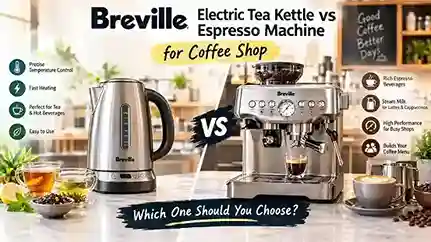
Electric Kettle for Coffee Shop Whether it is setting up or upgrading a coffee shop, selecting the right equipment will make significant difference in terms of speed, drink quality, consumer satisfaction, costs. A Breville electric tea kettle and a commercial espresso machine are two appliances that may seem worlds apart, but they can both be equally relevant to a beverage-centric business.
The best selection for you will depend on what your coffee shop is selling, how many customers you are serving and whether or not the menu has a primary or blended focus centered around coffee or tea.
So, this guide compares a Breville electric tea kettle vs espresso machine for use by the coffee shop from their functions, and performance to speed, capacity, ease of use and maintenance along with energy consumption.
Breville Electric Tea Kettle vs Espresso Machine: The Main Difference
The main difference between the two is their aim.
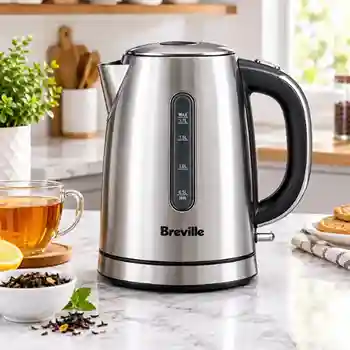
Breville electric kettle is mainly equipped to boil water quickly and precisely. It is ideal for tea, pour-over coffee, instant drinks, French press coffee and other drinks that require hot water.
Meanwhile, an espresso machine is designed to specifically pull shots of intense coffee under pressure. This is an integral ingredient in espresso-based drinks including lattes, cappuccinos, Americanos, macchiatos and flat whites.
So these appliances aren’t really direct replacements for one another. They are rather solving separate issues inside a coffee shop.
If you sell espresso drinks, then your first machine should be an espresso machine. A good electric kettle can be a helpful appliance if your menu features many teas or brewed coffee made by hand.
What Is a Breville Electric Tea Kettle?
The company Breville is quite famous for its high-end kitchen and beverage products. Like all the other kitchen appliance, Cuisinart electric kettles mainly emphasize ease of use, heat control desirable aesthetic features and fast heating time.
This is particularly helpful, when making different types of tea as well. While green tea, white tea, black tea, herbal tea and specialty teas may require certain brewing temperatures.
Boiling water has a temperature of 100°C, but this is not suitable for all infusions such as green tea due to the delicate nature of its leaves. Staff can choose a more suitable temperature with a kettle that controls the heat.
Breville Electric kettle is also best for coffee shops providing:
- Green tea
- Black tea
- Herbal tea
- Specialty tea
- Pour-over coffee
- French press coffee
- Hot water beverages
- Instant coffee
- Hot chocolate preparation
The biggest benefit of this is flexibility if the business wants hot water rather than espresso
What Is a Commercial Espresso Machine?
When you work in a coffee shop, one of the most important tool you will receive is your commercial espresso machine.
It pushes hot water through pressurized finely ground coffee to produce espresso with a concentrated flavor, aroma, and crema.
You can craft popular beverages with a commercial espresso machine, including:
- Espresso
- Double espresso
- Americano
- Cappuccino
- Latte
- Flat white
- Macchiato
- Mocha
- Cortado
In a coffee shop where espresso-based drinks account for a significant percentage of the sales, the espresso machine is often a primary expenditure.
An espresso machine is not just designed to boil water like an electric kettle; it is built around the extraction of coffee.
Performance Comparison
When comparing a Breville electric tea kettle vs espresso machine for coffee shop applications, performance should be evaluated according to the job each appliance performs.
Breville Electric Kettle Performance
State-of-the-art in the category, an electric kettle that heats water fast and gives precise temperature adjustment. To top it off, during busy periods when a staff to make multiple kinds of drinks needed hot water, it’s convenient.
The strongest advantages you may experience in your room are temperature precision.
Employees select a specific setting and then focus on other tasks rather than estimating when water (or in some instances food) is boiling/other materials are cooking.
This could help make beverage preparation more uniform.
Espresso Machine Performance
An espresso machine takes an answer and ran a significantly more complex process. It needs to heat the water, maintain proper brewing conditions, deliver that water through the coffee grounds and often produce steam for espresso-based milk drinks as well.
Commercial espresso machines are built to brew drinks continuously during hours of operation.
With a busy coffee shop, how fast you can recover from an incident is critical to your success.
It is also wisdom to have the machine run continuously even in peak periods; if machine cannot perform, that can slow down services adherence and impact customer experience poorly.
Which Is Faster?
Speed is dependant on what you are making.
If your only purpose is to boil water, an electric kettle will mostly be the better solution.
It is clear that you need an espresso machine to prepare your espresso drinks.
For example a customer has ordered for a cup of green tea. There is no need for an espresso machine. A kettle that has built-in temperature control can heat the water you need much more efficiently.
Now consider this customer orders a latte. An espresso machine is the only thing that will do because a kettle cannot pull espresso or steam milk.
Crucially, speed is measured against the drink you have in mind.
Temperature Control
Speed is relative based on what you are cooking.
If you’re just looking to heat water, an electric kettle is usually the way to go.
An espresso machine, obviously required for making espresso drinks.
Suppose a customer25 requests for a cup of green tea. An espresso machine is not needed. They can heat the necessary water rapidly, and economically using a temperature-controlled kettle.
Now imagine, a customer orders a latte. A kettle can’t pull espresso or steam milk, so an espresso machine is a must.
One major area is temp control which a premium Breville electric kettle could really shine.
Various teas require different water temperatures to properly infuse them. Other furniture contributes to proper temperature selection, so that staff can reproduce drinks with better consistency.
This can be particularly useful for specialty tea menus.
Espresso machines also require temperature control, but relating to coffee extraction and milk steaming rather than heat up tea.
A good commercial espresso machine might have very advanced heating and temperature-control systems to provide a stable brewing environment for that ultimate beverage.
Capacity and Coffee Shop Workload
With increasing customer volume, capacity becomes more and more important.
Electric Kettles — A home-style kettle could be just right for a small café with less tea business, but in a high-throughput coffee shop it would need to be quite an extensive hot-water system or dedicated commercial brewing machines.
The same goes for espresso machines.
An espresso machine for a small café might be enough to pull some shots, but would likely suffer under the pressure of a busy morning rush.
When choosing equipment, consider:
- Number of customers per hour
- Average beverage orders
- Peak operating periods
- Number of employees
- Menu size
- Tea-to-coffee sales ratio
- Available counter space
Problems arise later when equipment is bought on the basis of looks or a low starting price.
Ease of Use
Electric kettles, on the other hand, tend to be easier in use and.
Staff usually just fills with water, set the temperature and turn on. The water can then be utilized for the beverage once it just touches the desired destination.
Training an espresso machine to operate is more challenging.
Employees may need to learn:
- Coffee grinding
- Dose management
- Tamping
- Espresso extraction
- Milk steaming
- Drink recipes
- Cleaning procedures
- Machine maintenance
And an employee training should be included in the total cost of ownership for a professional coffee shop.
Maintenance Requirements
Maintenance is another major difference.
Most electric kettle needs very simple care for maintenance. If you live in an area with hard water, cleaning and descaling regularly can help prevent it from building up.
For espresso machines, you have to do a lot more.
As machines get more complex, even staff can be required to clean machine parts on a daily basis depending on the level of use — back-flushing, cleaning group-heads and steam-wands among others.
May also have to be taken to professionals for service.
Remember that low quality of beverage and equipment short-life span can occur due to inappropriate maintenance way, so it is always recommended to strictly follow the maintenance tip by the manufacture.
Energy Efficiency
Energy consumption is related to the appliance, its model and type of usage pattern and operating environment.
An electric kettle typically heats the water only when required[4]. This might be effective for firms which set up comparatively small qualities of boiling water all day long.
Espresso machines often are held at temperature for very long times between uses to have them ready to make hot coffee drinks.
But comparing energy consumption based on the appliance itself is only part of the picture. How many drink does each Machine output, how long the appliance runs.
Counter Space
One of the biggest challenges in small cafés is space.
A smaller electric kettle will generally nicely fit on the countertop with other appliances.
The commercial espresso machines are comparatively larger and may need a countertop.
They will also likely need access to:
- Water supply
- Drainage
- Electrical power
- Grinder space
- Milk refrigeration
- Cup storage
Take measurement the available workspace accurately before buying an espresso machine.
Cost Considerations
The price is another significant aspect when you compare a Breville electric tea kettle vs espresso machine for coffee shop usage.
An inFAmous commercial espresso machine is usually far more expensive than a high end electric kettle.
But price should never be the only factor to consider.
It is a return of investment possible for the coffee shop to make?
If the majority of your customers are ordering lattes, cappuccinos and Americanos, an espresso machine is a direct way to help support revenue.
For example, if tea is a high percentage of sales it can be an awesome upgrade to switch to a good electric kettle for speed and consistency in prep.
The smartest way would be to buy equipment as per the real customer demand.
Breville Electric Kettle: Pros and Cons
Pros
- Temperature control as accurate on compatible models
- Quick hot-water preparation
- Easy to operate
- Useful for multiple beverages
- Smaller in size than traditional espresso machines
- Ideal for tea, or manual-brew coffee
- Generally simpler maintenance
- Lower initial investment
Cons
- Cannot make espresso
- Cannot steam milk
- Capacity is limited as compared to commercial hot-water systems
- For work, some models may only be intended for use at home
- Not suitable for industrial scale high performance commercial operations
Consider Using Both
For example, a coffee shop will have an espresso machine for espresso based drinks and use an electric kettle (or some manual brewing method) for tea as well.
This results in a station that is less flexible for beverages.
For example:
Espresso machine:
Plain lattes, cappuccinos and Americano first mocha espresso.
Electric kettle:
Tea (Green and Black), Herbal Tea, Pour-over Coffee & Other Hot-water Drinks
Utilising the two allows a business to accommodate both without having to manipulate one appliance into something it isn’t built for.
Best Choice for a Small Coffee Shop
Step 1: Analyze your menu For a small coffee shop with a limited budget, start with your menu analysis.
If coffee drinks are the largest sale category, then focus on the espresso setup.
Keep in mind that an espresso setup can also include a good grinder, supplies and tools to da it right based on what you want to do with your coffee shop, To name some: water, refrigeration, cups and cleaning.
That being said, if the shop is mainly a tea café, then an electric kettle with precise temperature control might be more suitable for opening.
If your coffee shop is a small business doing both, purchase the basic espresso gear and then get a kettle when you expand to selling tea.
Best Choice for a High-Volume Coffee Shop
Different sweet shops are for places having excess volumes like coffee outlets.
Equipment must be able to stand up to repeated use, while performing as expected.
If a business relies heavily on espresso, then the key machine for that facility is generally a commercial-grade espresso machine properly sized.
For tea-forward operations, you will likely find that a single-use commercial hot-water solution may be more suitable than continuing with your consumer kettle.
A Breville kettle still finds usefulness for specialty tea or manual brewing, though businesses should confirm that the model is appropriate for whatever their commercial workload requirements are (and claims about warranty conditions).
Final Verdict
The showdown of Breville electric tea kettle vs espresso machine for coffee shop ultimately is not about a single most nutritious winner.
They are made For different uses of appliances.
If your business requires rapid hot water for tea and manual brewing, a Breville Electric Kettle is an excellent investment as it will boil the water to the correct temperature automatically with no hassle.
The commercial espresso machine is best suited for you if your coffee shop relies heavily on lattes, cappuccinos, Americanos, macchiatos and other espresso-based beverages.
The strongest arrangement for a considerable lot of the cafés is to utilize both. The espresso machine is capable of extracting coffee as well as steaming milk for creating drinks whereas electric kettles are ideal to deliver accurate hot water for tea and manual brewing.

1 Comment
[…] Ginny’s Essential 2-Slice Toaster vs Portable Hot Water Heater […]